Qualified output
Concentrated material prepared for a target grade, chemistry, moisture and physical condition.
 Contact
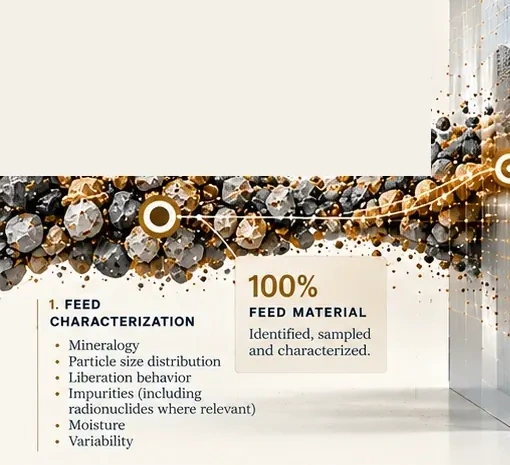
Changes in grade, mineralogy and impurities affect recovery, cost and the product that can be made.
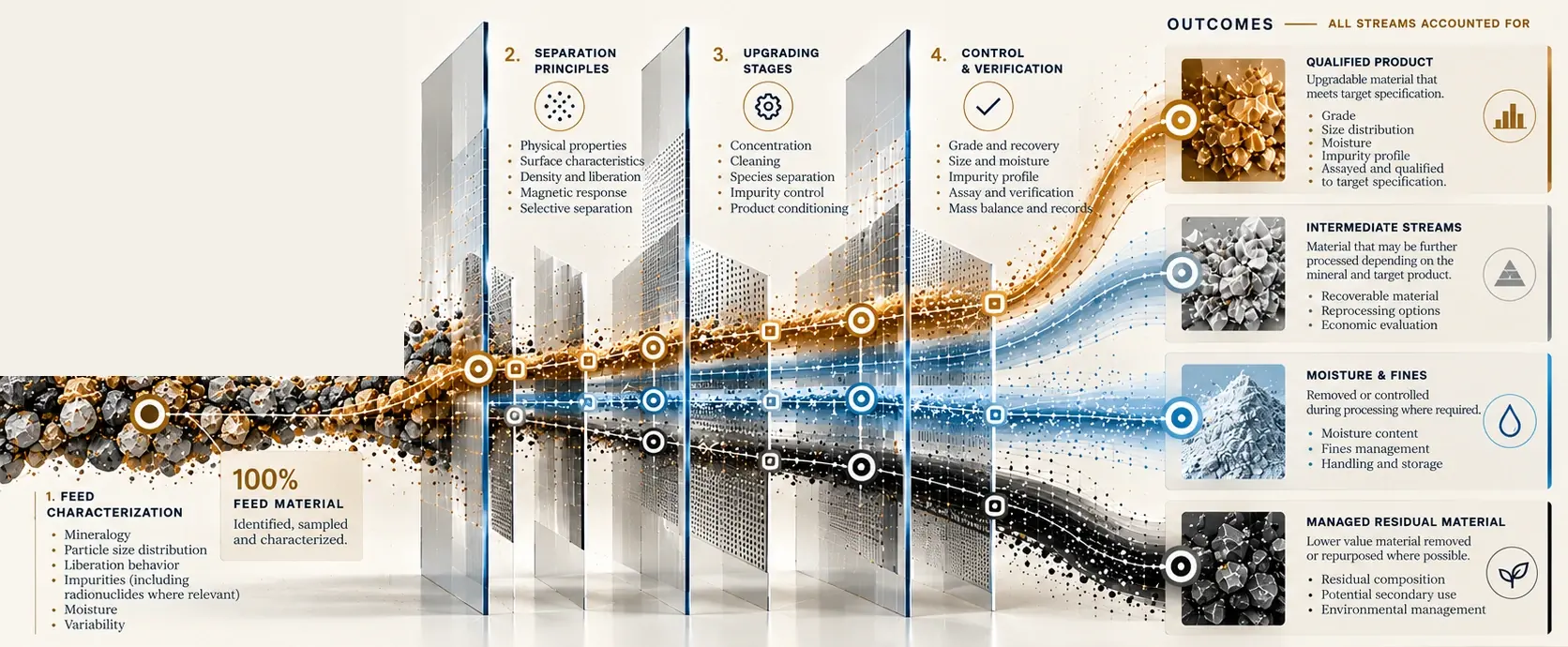
The complete process is shown above. Explore its stages in detail below.
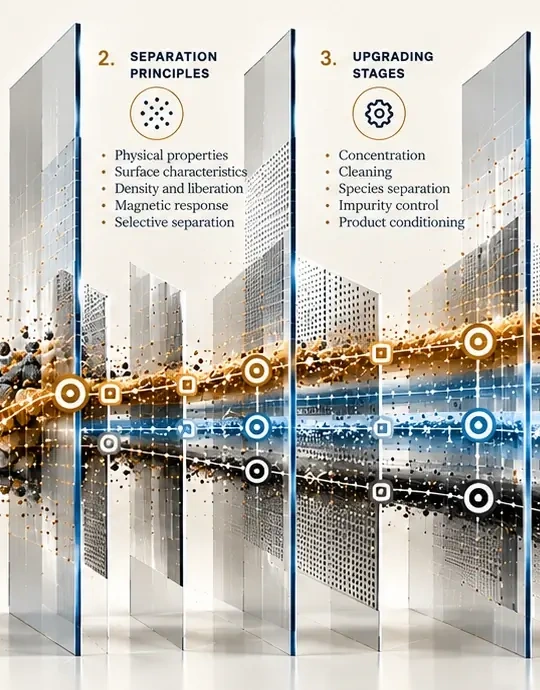
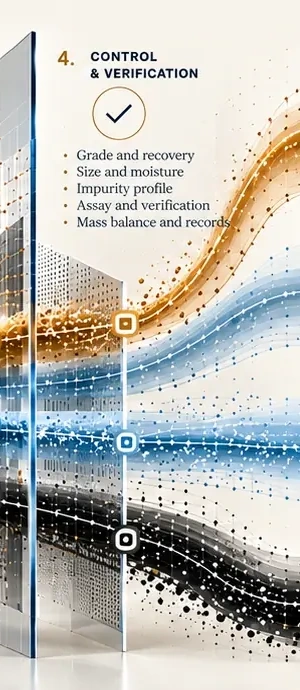
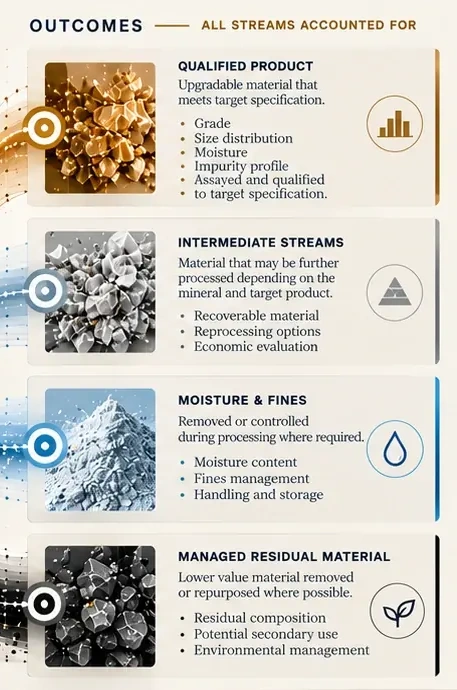
The process diagram follows the entire feed through separation, upgrading and verification. The relative share of each output depends on mineralogy, liberation and operating conditions—not only the grade of the incoming ore.
A material balance reconciles tonnes entering and leaving each stage. It reveals recovery losses, circulating loads and potential treatment options, while establishing the quantities requiring storage, additional processing or residue management.
Concentrated material prepared for a target grade, chemistry, moisture and physical condition.
A recoverable fraction that may need another separation or upgrading stage before it meets the sale specification.
Fine material can affect recovery, water handling and final product condition; its volume and characteristics must be understood.
Lower-value material is accounted for and managed according to its physical and chemical characteristics.
Geology, mineral species, grade distribution and available production records establish what the source can reasonably provide.
Sequence the mine around plant performance. Campaign planning, stockpiles and blending options can smooth abrupt changes in ore characteristics and reduce avoidable interruptions to the processing circuit.
Source identity and production records allow plant performance to be compared with the material actually processed.
Test work shows how material responds before the plant process is chosen: what can be separated, what may be lost and which impurities require control.
Depending on the mineral, preparation can involve sorting, crushing and sizing, gravity concentration, magnetic or electrostatic separation, flotation, cleaning and dewatering. The sequence is selected around recovery, grade, usable output and cost.
The best operating point is not necessarily the highest concentrate grade. Engineers balance saleable output against recovery loss, energy, reagents, water use and customer penalties to determine whether extra upgrading adds value.
Processing can concentrate the valuable fraction before shipment. Further conversion only makes sense where volume, utilities, controls and a customer justify it.
A successful assay is not enough on its own. Sampling, moisture, particle size, blending where needed, retained samples and independent assay show whether the process can reproduce the specified product across successive lots.
See where asset owners and technical specialists can contribute.